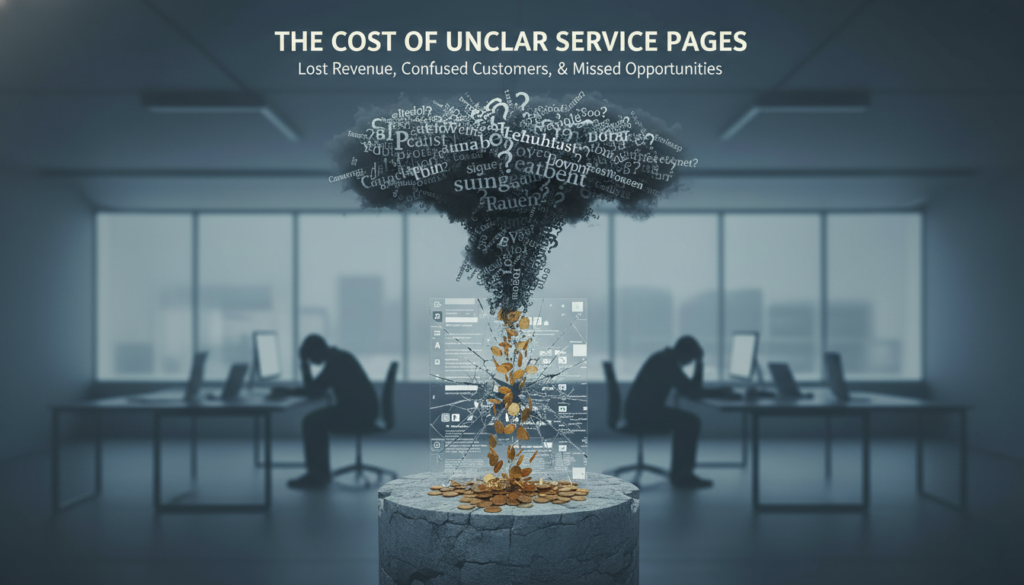
Many businesses invest time and money into getting traffic, yet still struggle to convert visitors into enquiries. One of the most common reasons is unclear service pages. When people land on your website, they are looking for certainty. If they cannot quickly understand what you offer, who it is for, and what to do next, they leave. This problem affects businesses across Australia, the UK, and the USA, regardless of industry size.
Service pages are not just informational pages. They are sales tools. When they lack clarity, the cost shows up in lost leads, lower trust, and wasted traffic.
Why unclear service pages hurt conversions
Visitors make decisions fast. Research and real-world testing show that most users decide whether to stay on a page within seconds. If your service page uses vague language, general promises, or confusing layouts, people hesitate. Hesitation kills action.
Unclear service pages often fail to answer basic questions. What problem do you solve? Who is this service for? How does it work? What happens next? When these answers are missing or buried, visitors feel unsure. In competitive markets, uncertainty pushes them straight to a competitor.
The hidden SEO cost of poor clarity
Search engines are getting better at understanding user intent. Pages that confuse users also confuse search engines. If visitors bounce quickly or do not engage, rankings suffer over time.
Clear service pages help align with real search behaviour. Long-tail searches like “local SEO services for small businesses” or “website maintenance for trades in Australia” work best when the page directly matches that intent. When content is vague, rankings and traffic quality drop together.
Even in highly regulated or technical fields, including nuclear-related industries, clarity matters. If complex services are not explained in plain language, trust erodes fast.
What clear service pages actually include
Effective service pages follow a simple structure. They explain the service in everyday language. They outline who it helps and why it matters. They show real outcomes instead of abstract claims.
Clear pages also guide the reader step by step. Headings should be specific. Calls to action should feel natural, not forced. When people know what to expect, they feel safer reaching out.
This approach works across regions because human behaviour does not change much between the USA, the UK, and Australia. People want clarity before commitment.
Key Points to Remember
- Unclear service pages lead to lost enquiries and wasted traffic
- Visitors decide quickly whether your service makes sense to them
- Search engines reward pages that match real user intent
- Clear structure builds trust and improves conversion rates
- Simple language outperforms clever wording every time
FAQs
Why do service pages fail to convert visitors?
They often fail because the service is not explained clearly or the next step is unclear.
How detailed should a service page be?
Detailed enough to answer common questions without overwhelming the reader.
Do clear service pages improve SEO rankings?
Yes, clarity improves engagement, which supports better search performance.
Should technical services be simplified for users?
Yes. Even complex or nuclear-related services should be explained in plain language.
How often should service pages be updated?
They should be reviewed regularly based on user behaviour and search trends.
If your service pages are costing you enquiries, we help businesses fix that. At Creative Web Guys, we create clear, conversion-focused pages that turn traffic into real leads. Learn more about how our service page optimisation and SEO strategy can help your business grow.