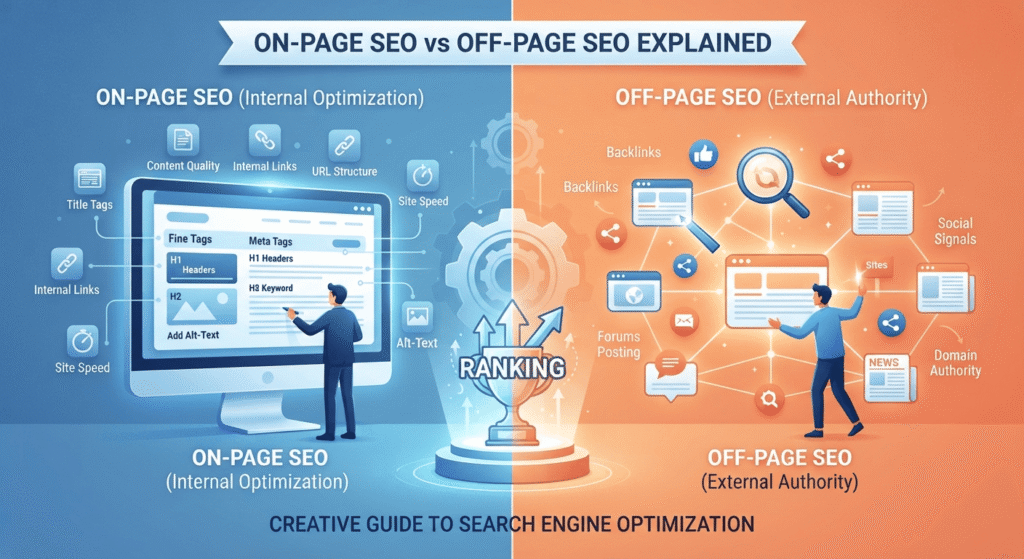
If you want your business website to appear higher in Google Search, you need to understand the difference between On-Page SEO and Off-Page SEO. Both are important parts of search engine optimization, but they focus on different areas.
For small businesses in Australia, the UK, and the USA, understanding these two SEO methods can help you improve website visibility, attract local customers, and generate more relevant organic traffic.
The simple difference is that On-Page SEO focuses on things you can improve directly on your website, while Off-Page SEO focuses on activities and signals outside your website.
What Is On-Page SEO?
On-Page SEO is the process of optimizing individual website pages so search engines and visitors can understand the content more easily.
Important On-Page SEO factors include:
- SEO title tags
- Meta descriptions
- H1, H2, and H3 headings
- Keyword optimization
- Website content
- Internal linking
- Image alt text
- SEO-friendly URLs
- Mobile-friendly design
- Page loading speed
- User experience
For example, a local plumbing company should not have one generic page called “Services.” Creating separate pages for emergency plumbing, water heater repair, drain cleaning, and residential plumbing services gives Google clearer information about what the business provides.
Using location-based keywords can also help. A plumber in London might target “emergency plumber in London,” while a plumbing company in Sydney could create content around “plumber in Sydney” or specific suburbs they serve.
What Is Off-Page SEO?
Off-Page SEO involves activities outside your website that can help establish its credibility and relevance.
The most commonly discussed Off-Page SEO strategy is link building. A backlink occurs when another website links to your website. Links from relevant and trustworthy websites can help search engines understand that your website is a useful resource.
Other Off-Page SEO factors can include:
- Business directory listings
- Local citations
- Customer reviews
- Industry websites
- Relevant backlinks
- Online brand mentions
- Local business partnerships
- Digital PR
For local businesses, local citations and Google reviews can be particularly useful as part of a broader Local SEO strategy.
On-Page SEO vs Off-Page SEO: What Should You Do First?
For most businesses, start with On-Page SEO.
There is little value in building backlinks to a website that has poor content, missing service pages, confusing navigation, or technical problems. Your website should first provide useful information and make it easy for customers to understand your services.
After the website foundation is improved, work on Off-Page SEO by earning relevant backlinks, building citations, collecting genuine customer reviews, and getting mentioned on appropriate websites.
How On-Page and Off-Page SEO Work Together
Think of your website as the place where customers learn about your business. On-Page SEO helps make that information clear and relevant. Off-Page SEO helps establish your business’s reputation outside your website.
For example, a local roofing company could create detailed service pages targeting roof repair, roof replacement, and emergency roof repair. The company could then build local citations, earn links from relevant construction websites, and encourage genuine customer reviews.
Together, these activities create a more complete SEO strategy for small businesses.
Common SEO Mistakes to Avoid
Some businesses focus too heavily on keywords and forget about the people reading the content. Repeating the same keyword excessively can make pages difficult to read.
Another common mistake is buying poor-quality backlinks. SEO should focus on relevant, trustworthy connections rather than collecting as many links as possible.
Businesses should also avoid copying content from other websites. Each important service page should provide original information that genuinely helps potential customers.
Key Points to Remember
- On-Page SEO focuses on your website’s content, structure, and technical elements.
- Off-Page SEO focuses on backlinks, citations, reviews, and external mentions.
- Keyword research helps identify what potential customers are searching for.
- Local SEO is important for businesses serving specific cities or areas.
- Build useful website content before focusing heavily on link building.
- Avoid keyword stuffing and low-quality backlinks.
- Consistent SEO work is more useful than short-term changes.
FAQs
What is the difference between On-Page SEO and Off-Page SEO?
On-Page SEO improves elements directly on your website, while Off-Page SEO focuses on external factors such as backlinks, citations, reviews, and online mentions.
Which is more important, On-Page SEO or Off-Page SEO?
Both are important, but businesses should generally make sure their website and content are properly optimized before investing significant effort into Off-Page SEO.
What are examples of On-Page SEO?
Examples include keyword optimization, title tags, meta descriptions, headings, internal links, image optimization, URLs, website content, mobile optimization, and page speed.
What are examples of Off-Page SEO?
Examples include backlink building, local citations, business directories, customer reviews, online mentions, industry websites, and local partnerships.
How does On-Page SEO help local businesses?
It helps businesses create pages that clearly target their services and locations, such as “electrician in Birmingham” or “roof repair in Melbourne.”
How does Off-Page SEO help Google rankings?
Relevant external signals, particularly quality backlinks and local references, can help search engines understand the authority and relevance of a website.
How long does SEO take to work?
There is no fixed timeframe. Results depend on factors such as competition, website quality, location, industry, existing authority, and the consistency of SEO work.
If you want to improve your website using On-Page SEO and Off-Page SEO, we can help review your current website, identify SEO opportunities, and develop a practical strategy based on your business and target location. Learn more about how Creative Web Guys can help with SEO services for small businesses.