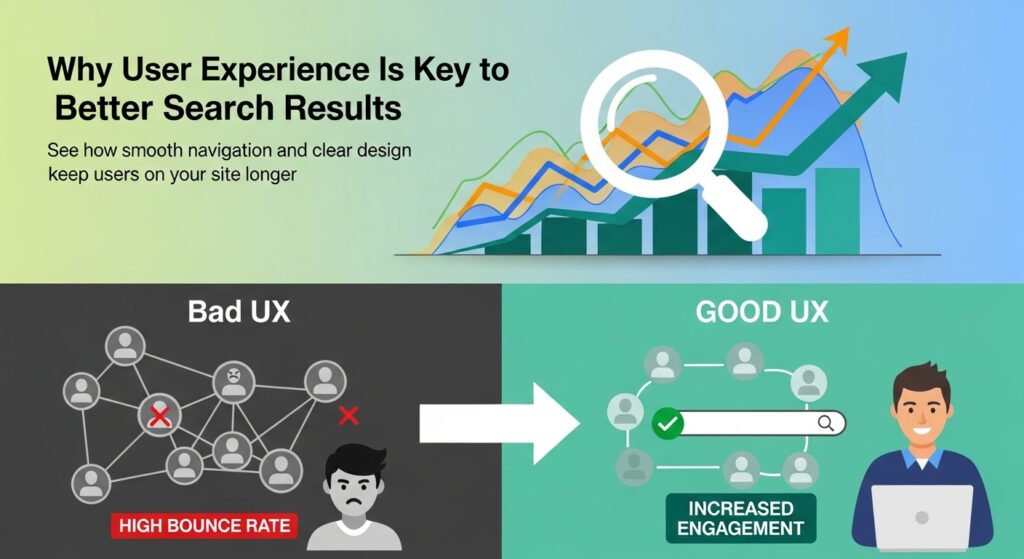
See how smooth navigation and clear design keep users on your site longer.
Search engines focus on user behavior more than ever. They track how visitors interact with your website, how long they stay, and whether they return. These signals help Google and other search platforms decide which websites deserve higher rankings. A positive user experience is now a direct path to better search visibility.
How User Experience Shapes SEO
When someone visits your site and leaves quickly, search engines assume the content or layout didn’t meet their needs. This increases your bounce rate, which can hurt your ranking.
But if people explore your pages, read your content, and click through to other links, Google sees it as proof that your site is useful and relevant.
Smooth navigation, simple menus, and fast load times keep users engaged longer. These small details help your website perform better both for visitors and for search algorithms.
The Importance of Simple Design
People judge websites fast. If your layout feels confusing or cluttered, they’ll move on. A clean design with readable fonts, clear images, and structured spacing helps users find what they’re looking for without frustration.
Also, with most searches now happening on mobile devices, your site must load quickly and display correctly on smaller screens. Slow or unresponsive pages lead to traffic loss and missed conversions.
Why Trust and Ease Go Together
User experience is not only about looks. It’s about how safe and confident people feel while browsing your site. Adding visible contact information, privacy assurance, and genuine reviews builds credibility. When users trust your site, they stay longer and are more likely to make a purchase or enquiry.
Search engines pick up on this behavior, rewarding websites that people interact with and revisit.
Local SEO and User Experience
If your business serves a local audience, user experience has an even bigger role. Clear location details, quick directions, and click-to-call buttons make it easier for users to take action.
Adding a Google Map, consistent NAP (name, address, phone number), and customer testimonials can help improve both your local ranking and conversion rate.
Key Points to Remember
- Make your website fast, mobile-friendly, and easy to use.
- Use clear menus, simple layouts, and short paragraphs.
- Add trust factors like reviews and visible contact details.
- Keep visitors engaged with related internal links.
- Test your website on multiple devices regularly.
Frequently Asked Questions
1. How does user experience affect SEO rankings?
Search engines use engagement signals like time on site and bounce rate to decide how useful your page is. A better user experience keeps visitors longer, improving these metrics.
2. What design elements improve user experience the most?
Fast load times, mobile responsiveness, clean layout, readable fonts, and logical navigation have the strongest impact.
3. Does mobile experience really affect search ranking?
Yes. Google uses mobile-first indexing, meaning it ranks based on how your site performs on mobile devices.
4. How can I measure user experience on my website?
Use tools like Google Analytics to track bounce rate, average session time, and user flow. Heatmaps and behavior tracking also show where visitors click or leave.
5. What is the link between UX and conversions?
When your site is easy to use and feels trustworthy, visitors are more likely to complete actions like form submissions, calls, or purchases.